

SC Acquits Man in Murder Case Over Discrepant Medical Evidence and Hostile Witnesses
 Copy Link
 Share
Share Save
Save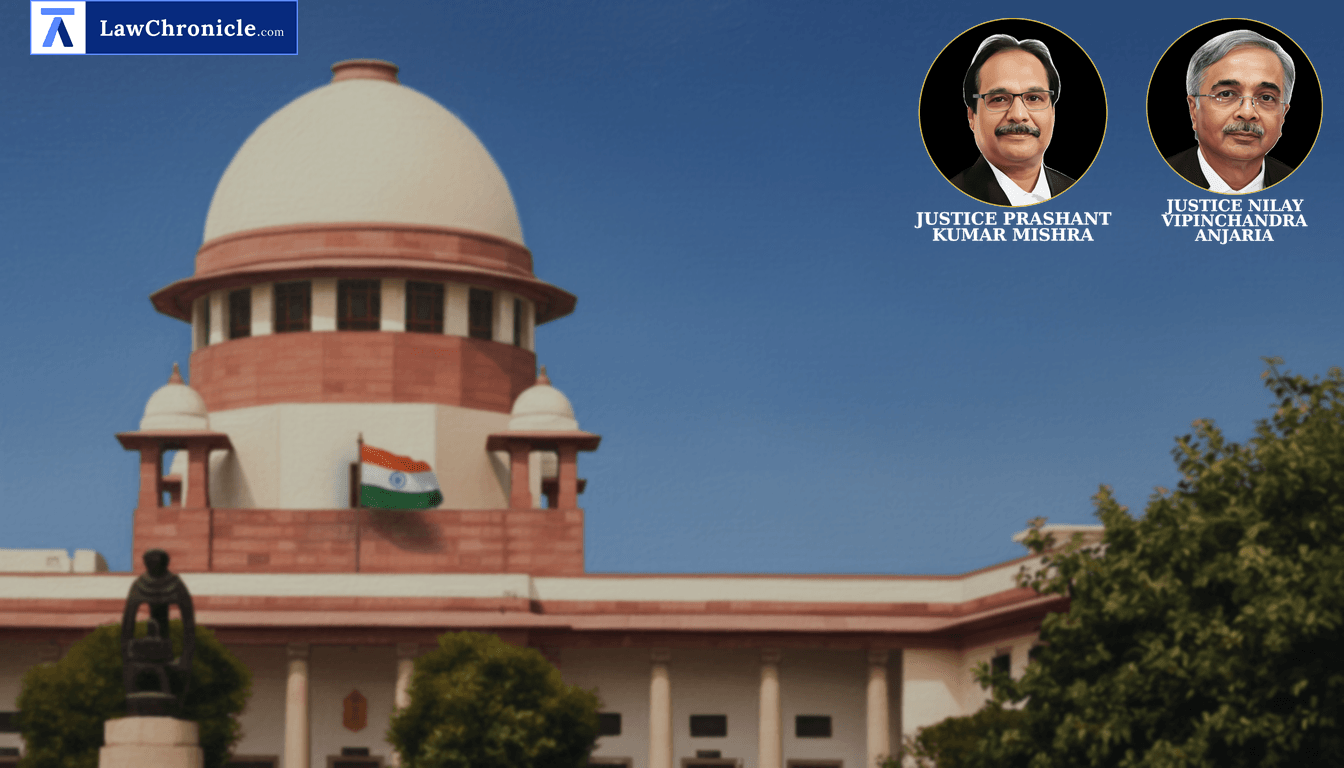
In a significant ruling, the Supreme Court set aside the conviction of a man accused of murder and caste-based atrocities, citing 'weak, contradictory and crumbling evidence' that failed to establish the occurrence of the incident or the motive. The apex court emphasized that while the testimony of hostile witnesses can be used for conviction, it can equally be applied to discredit a prosecution's case and support an acquittal if it inspires credibility.
A bench of Justice Prashant Kumar Mishra and Justice N.V. Anjaria heard the appeal challenging the Telangana High Court's decision to uphold the appellant's life sentence. The Court scrutinized the reliability of 'interested witnesses' and the evidentiary value of a post-mortem report fraught with irreconcilable discrepancies regarding the time of death and the conclusion of the autopsy.
Analysis of Hostile Witnesses and Interested Testimony
The prosecution's case rested heavily on the testimony of the deceased’s mother and a friend who was allegedly present during the assault. However, the Court observed that the friend, who turned hostile, directly contradicted the mother's narrative. The Court noted that the incident allegedly took place on a busy public road, yet no independent witnesses were examined.
The Court, in its reasoning, observed: "... as the evidence of a hostile witness can be used for convicting the accused, such evidence could indeed be applied and utilised also for the purpose of acquitting the accused, when what is testified by the hostile witness inspires credibility, when read with the other evidence on record, either ocular or documentary. ."
Judicial Skepticism Toward Medical Reports
A critical factor in the acquittal was the flawed medical evidence. The Court highlighted that the post-mortem report signed by the medical officer contained dates and times that did not correlate with the timeline of the death, and the wound certificate was undated. Relying on Ghulam Hassan Beigh vs. Mohammad Maqbool Magrey and Others ( "(2022) 12 SCC 657": 2022 CaseBase(SC) 1192), the Court reiterated that a post-mortem report is not substantive evidence by itself and must be corroborated by oral testimony.
Regarding the testimony of related witnesses, the Court referred to Masalti vs. State of Uttar Pradesh ( "[1964] 8 SCR 133": 1964 CaseBase(SC) 74) and Bhaskarrao and Others vs. State of Maharashtra ( "(2018) 6 SCC 591": 2018 CaseBase(SC) 948), noting that while their evidence isn't automatically rejected, it must be weighed with 'extra caution' when it suffers from contradictions. The Court concluded: "In wake of such weak, contradictory and crumbling evidence, where the prosecution miserably struggled to be finally unable to prove its case, the conviction recorded by the Trial Court and confirmed by the High Court is not sustainable."
Background:
The dispute originated from an alleged elopement involving the appellant’s sister and the deceased in village Ogipur. The prosecution claimed a village Panchayat had ordered the deceased to leave the village, but he returned to attend a wedding, leading to a fatal confrontation on May 12, 2013. The appellant was subsequently convicted by the Special Sessions Judge under Sections 302 and 323 of the Indian Penal Code, 1860 and various sections of the The Scheduled Castes and The Scheduled Tribes (Prevention of Atrocities) Act, 1989.
In the appeal, the Supreme Court found that the prosecution failed to prove the 'genesis of the incident' the holding of the Panchayat as multiple witnesses denied it ever occurred. Combined with the suspect medical findings and the lack of independent ocular evidence despite the public location, the Court found the concurrent findings of the lower courts to be erroneous.
Case Details:
Case No.: CRIMINAL APPEAL NO._______ OF 2026 (Arising out of SLP(Crl.) No.13614 OF 2025)
Case Title: TALARI NARESH VS. THE STATE OF TELANGANA
Appearances:
For the Petitioner(s): Mr. D. Ramakrishna Reddy, Counsel; Mrs. D. Bharathi Reddy, Advocate-on-Record
For the Respondent(s): Mr. Kumar Vaibhaw, Counsel; Mr. Devina Sehgal, Advocate-on-Record
Source: 2026 CaseBase(SC) 410
 Breaking News